
Part 8 of 8: The Hidden Advantage Finance Has in Strategy (And Why They Rarely Use It)
Roger Knocker • January 29, 2026
Part 8 of 8
████████
You don’t need to be a strategy guru. You just need to keep the beat.

Strategy intimidates many finance professionals, not because we lack intelligence, but because we assume we need to arrive as “strategy experts.”
We picture consultants with frameworks, CEOs with whiteboards, executives with buzzwords.
But here is the truth:
Finance has a built-in advantage in strategy that no other function has, and most teams never use it.
And funnily enough, I learned this lesson years ago,
behind a drum kit at a youth camp.
The Four Types of Drummers I Met at Camp
I used to organise the music at youth camps. I was the drummer.
And without fail, teenagers would line up after the evening service and ask:
“Please can you teach me the drums?”
I would always oblige.
Over time, I realised these camps produced the same four types of drummers,
and each one mirrors how finance professionals show up in strategy.
1) Lee. The Beginner
Lee sits down full of nerves and excitement.
I show him the basics:
•
Count 1 2 3 4,
•
Cross your hands like this,
•
Keep the hi-hats closed,
•
And try not to strangle the drumsticks.
At first, Lee’s forehead folds into that classic teenage frown of concentration.
He is trying so hard not to lose the beat.
Then suddenly he gets it.
His whole face lights up.
A huge grin breaks through.
Everyone cheers.
Most finance teams today?
In strategy terms, they are still Lee.
Capable, eager, but early in the journey.
2) Greg. The Enthusiast
Greg was unforgettable.
The moment he figured out a basic rhythm,
he never stopped.
For the rest of the weekend:
•
bang bang bang during volleyball,
•
bang bang bang in the food queue,
•
bang bang bang at 7am outside the cabins.
We loved Greg’s passion,
but we also wished he came with a volume knob.
This is the finance person who thinks they are “doing strategy”,
lots of noise, no structure, no process.
Fun? Yes.
Useful? Not always.
3) Ross 1.0. The Functional Part-Timer
And then there was Ross.
Ross was different.
After camp, he got permission to practice.
He saved up.
He bought his own drum kit, and he put in the work.
He wasn’t trying to be a star.
He just practised consistently.
Within months he was drumming in the church band,
a functional, reliable part-timer who made the band work every weekend.
Not flashy.
Not elite.
But absolutely essential.
This is exactly where Finance needs to be to lead strategy:
Ross 1.0. Structured, disciplined, consistent, value-adding.
This level alone changes the trajectory of a finance team and elevates its influence in the business.
4) Ross 2.0. The Serious Musician
A few years later, Ross returned transformed.
He and his brother had formed a band.
They practised constantly.
They played weekly gigs, paid rock and jazz shows at real venues.
They weren’t amateurs anymore.
They were a proper band, tight, polished, respected.
This is Finance when it matures into:
•
OKRs
•
corporate alignment
•
scenario modelling
•
enterprise portfolios
•
KPI architecture
•
integrated planning
Powerful.
But not required to start.
5) Kenny. The Session Pro
Years later, I joined another church band, and that is where I met Kenny.
Different world.
Different level.
Kenny was a professional session drummer.
He would walk into a studio, sight-read complex drum charts and nail the performance on the first take.
This is the equivalent of a global strategy expert or top-tier CFO.
Impressive.
But most organisations don’t need this yet.
So, What’s the Hidden Advantage Finance Has?
Strategy requires:
•
structure
•
rhythm
•
consistency
•
disciplined follow-through
•
connecting drivers to outcomes
•
asking the right questions
Finance already does all of this every month,
every quarter,
every year.
Finance is the only function in the business that:
•
understands drivers
•
understands measurement
•
understands cause and effect
•
can build projections
•
can quantify decisions
•
can bring order to noise
•
can see value clearly
This is the hidden advantage.
Finance is wired to lead strategy,
but rarely steps into the role.
You Don’t Need Kenny. You Only Need Ross 1.0.
To step into strategic leadership, Finance does not need:
•
advanced frameworks
•
consultant-level jargon
•
full strategy toolkits
•
or a decade of training
You need:
•
an intake sheet
•
a profit funnel
•
a weekly drumbeat
•
clarity when others get stuck
•
discipline when others lose focus
•
the courage to put up your hand and guide the room
Everything in the earlier articles in the series (Part 1 - 7 of8) is “Ross 1.0 level”,
simple, consistent, practical, powerful.
When you operate with Ross 1.0 rhythm:
•
you stand out from the crowd
•
executives notice you
•
people talk about you
•
and organisations start asking for you by name
You become the finance leader who
keeps the beat, drives the value, and leads the strategy.
And all you needed was rhythm.

Learn how finance teams can automate routine work, improve month end reporting and use AI to create more time for analysis, insight and decision making.
Discover how finance teams can automate routine work, reduce manual effort and use AI to create more time for analysis and better decision making.
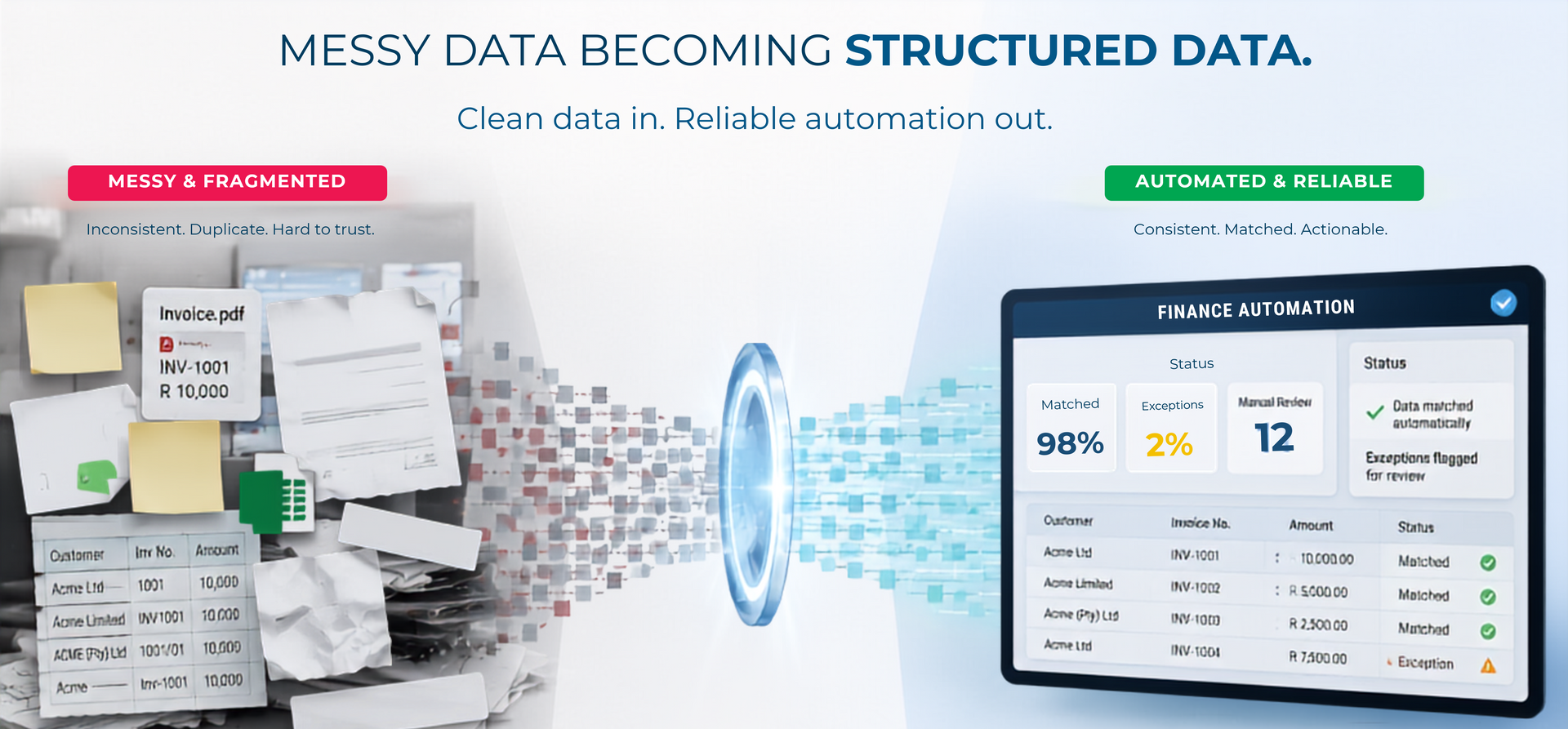
Why does master data integrity matter for finance automation? Learn how clean, standardised data improves automation, reporting and account reconciliations.
Learn how AI, process mapping, and workflow optimisation help finance teams eliminate bottlenecks, reduce duplication, and improve business performance.
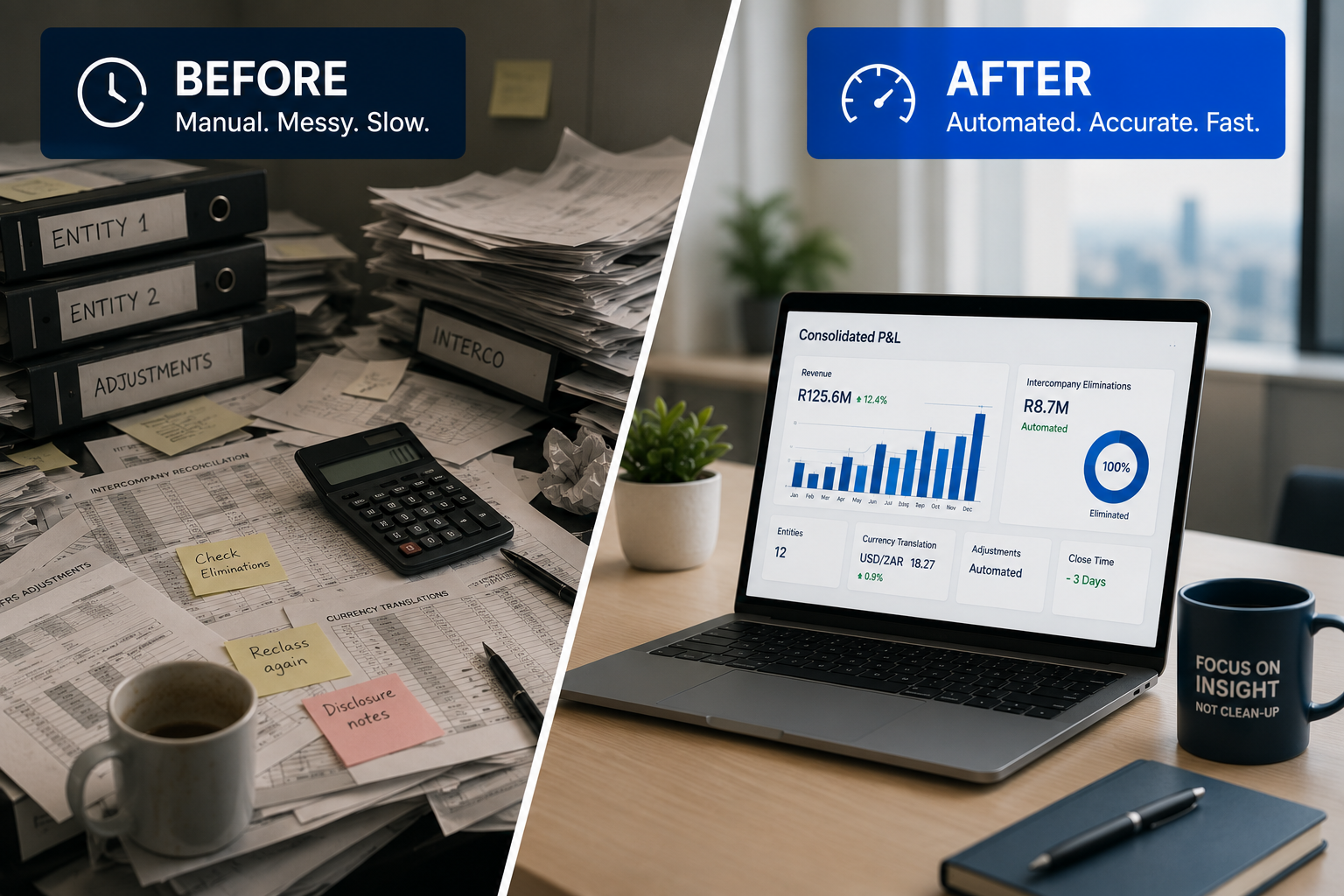
Consolidation software automates eliminations, currency translation and reporting so finance teams can spend less time reconciling and more time analysing.

Discover why hockey stick forecasts often fail and how driver based forecasting helps finance teams make better decisions with confidence.

Before automation, dashboards or AI can succeed, finance teams need trusted data. Discover the foundation of successful finance transformation.

Most finance automation projects fail because teams focus on process maps instead of business outcomes. Learn the five step approach successful finance teams use to automate faster and deliver measurable results.

Before automating finance processes, map and understand workflows to avoid scaling inefficiencies and ensure meaningful results.

Activity-based costing reveals hidden costs below gross profit, helping finance teams understand true profitability and improve decision-making.
Learn how finance teams can automate routine work, improve month end reporting and use AI to create more time for analysis, insight and decision making.
Discover how finance teams can automate routine work, reduce manual effort and use AI to create more time for analysis and better decision making.