
Understanding True Cost-to-Serve with ABC Analysis

Roger Knocker • June 1, 2026

Profitability isn’t always where you think it is
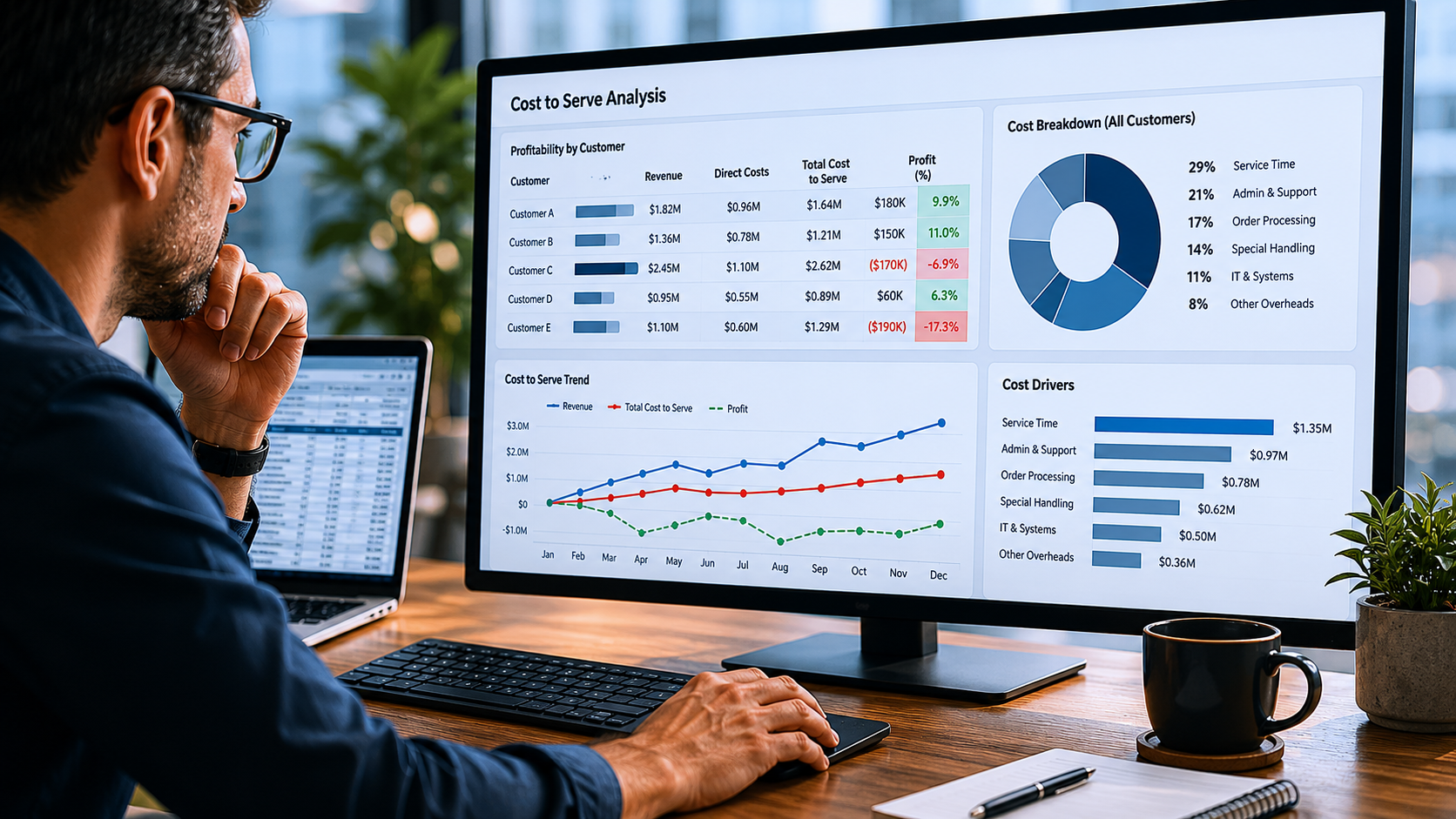
Most finance teams know their direct costs. ERP systems do a decent job of tracking those.

But very few really know the True Cost-to-Serve.


That is where activity-based costing (ABC) comes in. It is not new. Kaplan and Wilson introduced it 30 years ago, but back then it was too demanding to put into practice. Today the methods are simpler, the tools are better, and the insight is too valuable to ignore.


Here is what ABC gives you:

1️⃣ A clear view of whether profitable customers are cross-subsidising the loss-makers
2️⃣ An understanding of which clients you are over-servicing, and whether it is justified
3️⃣ Options to test different business models, web, distributor, agent, or direct
4️⃣ Clarity on whether your pricing is right, or significantly off
5️⃣ A spotlight on inefficiency inside your own processes


I once worked with a business convinced their biggest customer was their most profitable. On the surface, the revenue and direct costs looked fine. But once we allocated the overheads, the service time, admin support, and special handling, it turned out that customer was a loss-maker.


That is what advanced analysis really does. It does not just tell you “we missed target.” It tells you why, and what to do about it.


Once you understand the real cost to serve, you unlock choices:

  • Do we adjust the price?
  • Do we change the model?
  • Do we scale back the service levels?
  • Or do we carry this customer for strategic reasons while they grow?

Profitability is not always where you think it is. Advanced analysis, built on ABC, helps you see clearly where it is created and where it is leaking.
By Roger Knocker June 2, 2026
In this episode of the FP&Ai Podcast, Roger Knocker is joined by Anthony Wilson and Donovan Moses to explore the third vital component of the Finance Operating System: Accelerating Analysis. Now that we have addressed removing friction and automating workflows, we focus on how to transform that efficiency into high-speed, actionable intelligence for the boardroom. The discussion centres on the "Last Mile" of finance, moving from just producing reports to delivering real-time strategic insights. We unpack how a robust systems architecture allows finance teams to pivot instantly from historical reporting to forward-looking scenario planning. By shifting the workload away from data collection, leaders can spend more time on the "Why" behind the numbers. The key takeaway: Acceleration in finance isn't about working faster; it's about building a system that delivers insights at the speed of business. [0:00 - 1:30] Introduction to Standardized Workflows: The team defines the importance of standardized workflows in finance, emphasizing the need for repeatable, tracked, and timely processes that ensure the right tasks are performed by the right people. [1:30 - 4:21] Benefits of Workflow Automation: The discussion covers how workflows improve management visibility, accountability, and the ability to monitor progress, using a procurement process as a practical example to illustrate routing and authority limits. [4:21 - 7:28] Workflows Outside of the ERP: The guests explain how teams can leverage tools like HubSpot, Google Docs, Zapier, and Smartsheet to automate non-ERP processes, such as commercial inquiries and low-risk, recurring journal entries. [7:28 - 9:10] Implementing Daily Checks: The team highlights the necessity of implementing daily quality checks for automated workflows to detect and resolve failures, ensuring that critical data remains accurate. [9:10 - 12:09] Using Forms for Validation: A key tip is shared regarding the use of data entry forms to enforce structure, validation, and quality at the source, preventing errors in shared spreadsheets. [12:09 - 14:15] Documenting for Success: The conversation concludes by stressing the importance of documenting processes before automating them, focusing on routine, low-risk tasks to maintain human oversight where necessary while building a more robust finance system.
By Roger Knocker June 2, 2026
In this episode of the FP&Ai Podcast, Roger Knocker is joined by Anthony Wilson and Donovan Moses to explore the next evolution of the Finance Operating System: the shift from manual intervention to high-level automation and systemisation. Building on our previous discussions, we unpack why simply "working harder" is no longer a viable strategy for modern finance teams. The conversation centres on how to build resilient systems that run independently of individual effort, allowing finance professionals to move away from mundane data entry and toward high-impact strategic analysis. We discuss the practical steps to audit your current workflows, identify automation opportunities, and implement a "system-first" culture that eliminates human error and drives enterprise value. The key takeaway: To scale a business, you must first automate the friction out of your finance function. [0:00 - 1:22] Introduction and Reconciliation Quality: The team introduces the importance of reconciliation as a core finance process to ensure accurate, timely month-end closures. [1:22 - 3:51] Why Reconciliations are Necessary: They explain that reconciliations are vital for verifying the factual accuracy of invoices, pricing, and quantities, and for resolving timing discrepancies caused by cutoff dates. [3:51 - 6:53] Managing Third-Party Documentation: The speakers discuss managing rules for third-party documentation, including setting thresholds for approvals and using ERP systems to maintain process integrity during month-end. [6:53 - 8:33] Impact on Planning and Forecasting: Anthony Wilson highlights how accurate reconciliation is critical for reliable cash flow forecasting, noting that errors can lead to poor strategic decision-making. [8:33 - 11:50] Moving Beyond the "Finance Burden": Donovan Moses illustrates how teams are often "burdened" by disparate systems and manual work, proposing a transition to a digitized environment that acts as a bridge to a single version of the truth. [11:50 - 15:57] System Maturity and Standardization: The panel discusses building maturity one step at a time, suggesting that even if a team is still using Excel, they should implement standardized templates and rigorous monitoring to maintain audit trails and efficiency. [15:57 - 17:14] Summary: They conclude by emphasizing that strong master data governance and enforced reconciliation discipline are two essential pillars for building a sustainable and high-quality finance function.
More Posts