Why Master Data Integrity Is Key to Finance Automation Success

Automation can only work with the data you give it. Get the foundations wrong, and you risk scaling the problem instead of solving it.
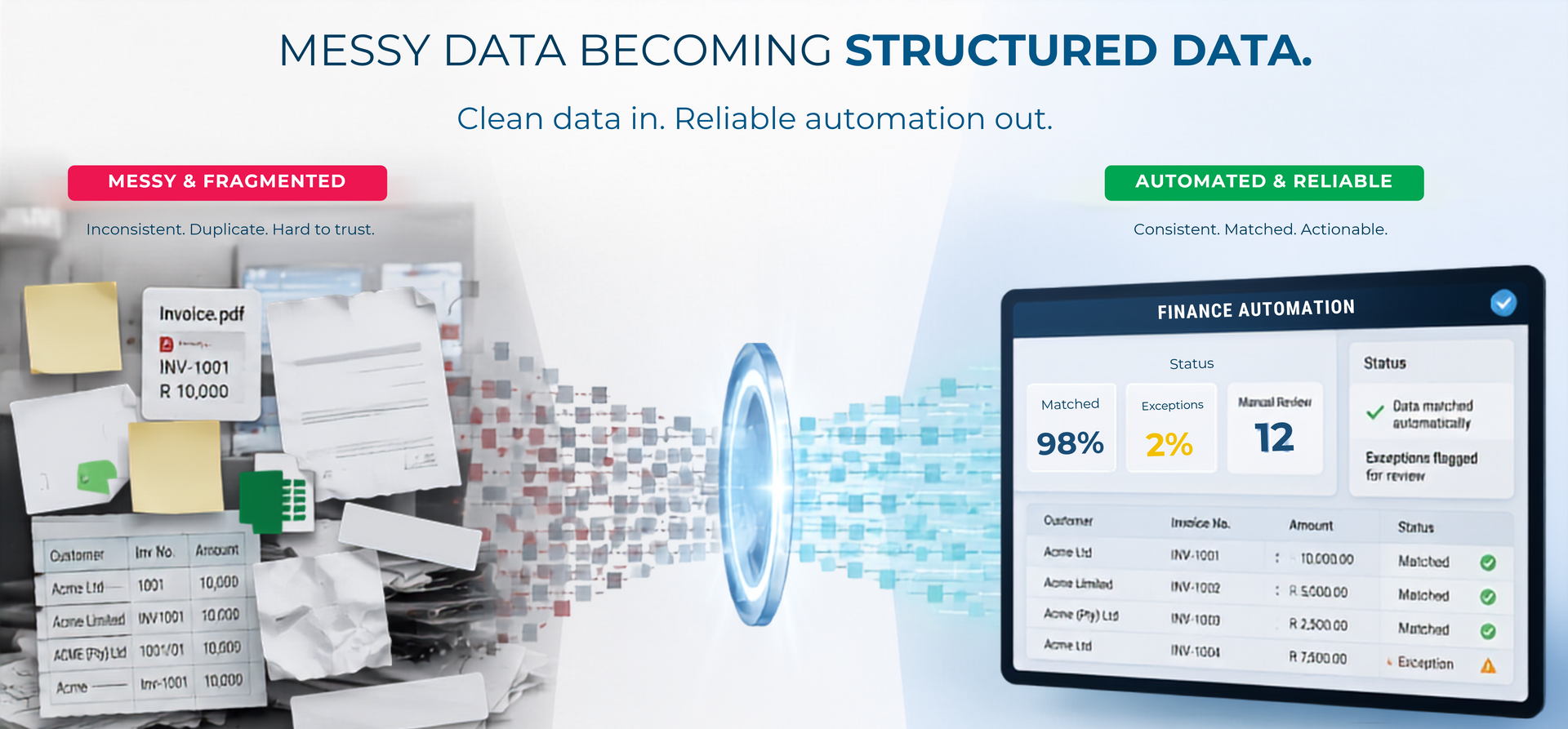
If your master data is wrong, automation amplifies the mess.
According to Gartner, poor data quality costs organisations an average of US$12.9 million per year. Duplicates, inconsistent records and fragmented data across systems are not just administrative problems.
The moment you automate finance processes on top of that, you're scaling the problem, not solving it.
Master data is the core information your business relies on repeatedly, including customer, supplier and product records. If that data isn't accurate, consistent and standardised, the rules behind your finance automation have an unreliable foundation.

1. Start with master data integrity
If your customer, supplier and product data isn't clean and standardised, automation can fail before it starts.
The rules you're automating need reliable data to run on. Otherwise, you're just creating noise.
2. Pick the easy wins for finance automation
Repeatable monthly reports are a good place to start. They follow rules and happen on a schedule. Document the logic, make sure the underlying data is reliable, then automate them.
Standardised data formats make everything easier. If you can agree with suppliers, partners and customers on how you'll exchange data, reconciliations become much more straightforward.
3. Improve the process, not just the reconciliation
Most reconciliation pain comes from upstream issues, including returns, short deliveries, short payments and email notifications with little or no context.
If you can fix those processes with better systems and forms, you may avoid the reconciliation entirely.
When both parties have data in the right format, the system can reconcile transactions automatically. But if the information is scattered across emails, spreadsheets and other sources, you still need humans to piece it together.

Compare that with a standardised data exchange where both parties share transactions in an agreed format, with the same fields, the same structure and the same cadence. The system can match transactions automatically, flag exceptions, and you only need to look at what doesn't reconcile.
The difference isn't necessarily the automation tool. It's whether the data feeding into it is fit for purpose.
Account reconciliations are time consuming by default because the people you're reconciling with don't necessarily use the same systems as you. They've got their version of the truth, and you've got yours.
But if you can standardise the exchange format and improve your master data quality, account reconciliation automation becomes far more achievable.
Clean data doesn't make automation exciting.
It makes automation work.